Effects of AM fungi on the response of alfalfa to aphid stress
Author:南京维百瑞生物科技有限公司
Click:
Time:2020-10-12 14:00:16
Chinese Title: Effect of AM Fungi on the Response of Alfalfa to Aphid Stress
Author: Lee Ying-de Ding Tingting segment Ting Yu
Published by: State Key Laboratory of Grassland Agro-ecosystems, Lanzhou University
Chinese core journal: Journal of Grass Industry
Research Background:
With the continuous development of society, people's living standards are improving day by day, and the demand for animal products is increasing day by day. The development of animal husbandry has become an inevitable trend, and alfalfa, as the most widely cultivated leguminous forage in China, directly affects the healthy development of my country's animal husbandry. However, there is a lack of resistant varieties of alfalfa, and most of the production practices use chemical methods to control alfalfa pests. However, chemical control will cause residual efficacy, lead to environmental pollution, reduce the quality of forage, and then affect the health of livestock, resulting in huge economic losses. At the same time, plant-microbe-insect interaction is a hotspot of international research, and it is also an important direction for regulating pests in agricultural systems.
Research ideas
In this study, AM fungi was used as a biocontrol factor, and the regulation of pests has the advantages of green, environmental protection and sustainability. Using alfalfa as material, explore the biochemical mechanism of AM fungi in response to pea aphid stress. The results show that AM fungi can regulate the plant's own response to aphids by promoting plant growth and nutrient absorption, changing plant defensive enzyme activities and plant hormone signal substance content.
background knowledge
1: SA and NO, as plant hormone signal substances, play an important role in plant resistance. SA plays a vital role in regulating the systemic acquired resistance (SAR) of plants.
2: The increased activity of SOD, POD, and CAT will strengthen the plant's antioxidant defense system and improve the plant's resistance to adversity stress.
Main results:
1: Growth status of alfalfa and N and P content
Compared with the NM treatment, the N content in the stems and leaves of the inoculated roots and the N content of the roots of the G. vulgaris plants increased by 139.51% and 240.47%, respectively, and the P content in the stems and leaves were increased by 255.10% and 414.09% under the treatment of G. vulgaris The content of P in roots and roots increased by 163.92% and 351.13% after inoculation with intra-root balloon, and increased by 278.35% and 418.97% after treatment with G. juvenileus.

Legend: Contents of alfalfa stems and leaves N(a), roots N(b), stems and leaves P(c) and roots P(d) under the treatment of AM fungi and aphids
Note: NM, sterile root treatment; IR, inoculation with Glomus within the root; IC, inoculation with Glomus juveniles; A, aphid treatment.
Compared with the treatment without insects, the P content of alfalfa roots increased after aphids treatment, and the P content of the roots increased even more after inoculation with AM fungi. This may be a strategy for plants to cope with aphid stress, prompting plant roots to accelerate the absorption of P element, while AM fungi enhances this ability of plants, and the N content of plants and P content of stems and leaves were not significantly affected by aphid treatment. Impact.
2: Alfalfa antioxidant enzyme activity
Inoculation of AM fungi has a significant effect on the activities of POD and CAT in plants. Under the aphid-free treatment, compared with the non-inoculated AM fungus plants, the POD activity of alfalfa increased by 70.00% and 49.61% under the inoculation of G. intraroot and G. juvenileus, respectively. Compared with AM fungal plants, the treatment of G. radiata significantly increased the activities of POD and CAT by 63.67% and 44.61%. After inoculation with G. juveniles, only plant POD activity was significantly increased by 106.34%.
Aphid treatment significantly affected the POD and SOD activities of plants. In the alfalfa inoculated with G. larvae, POD activity was significantly increased by 57.16% after aphid treatment compared with the treatment without infestation. In the inoculated G. intraroot plants, the POD activity was also promoted after the aphid treatment, which increased by 9.69%, but the difference was not significant; in the alfalfa without AM fungus treatment, the alfalfa treatment was less than the infestation treatment, and the aphid treatment was significant Reduce plant SOD activity.

Figure note: SOD(a), POD(b), CAT(c) and PPO(d) activities of alfalfa treated with AM fungi and aphids
Note: NM, sterile root treatment; IR, inoculation with Glomus intraroot; IC, inoculation with Glomus juveniles; A, aphid treatment.
3: Alfalfa plant hormone signal substances
The AM fungus inoculation treatment significantly affected the SA content of alfalfa. Under the aphid-free treatment, compared with the treatment without AM fungus, the SA content of inoculated G. intraroot and G. juvenilea alfalfa increased by 7.80% and 9.62%, respectively, but the difference was not significant; while after the aphid treatment , The SA content of alfalfa increased by 29.97% after inoculation with G. vulgaris, and 19.30% under the treatment of G. vulgaris.
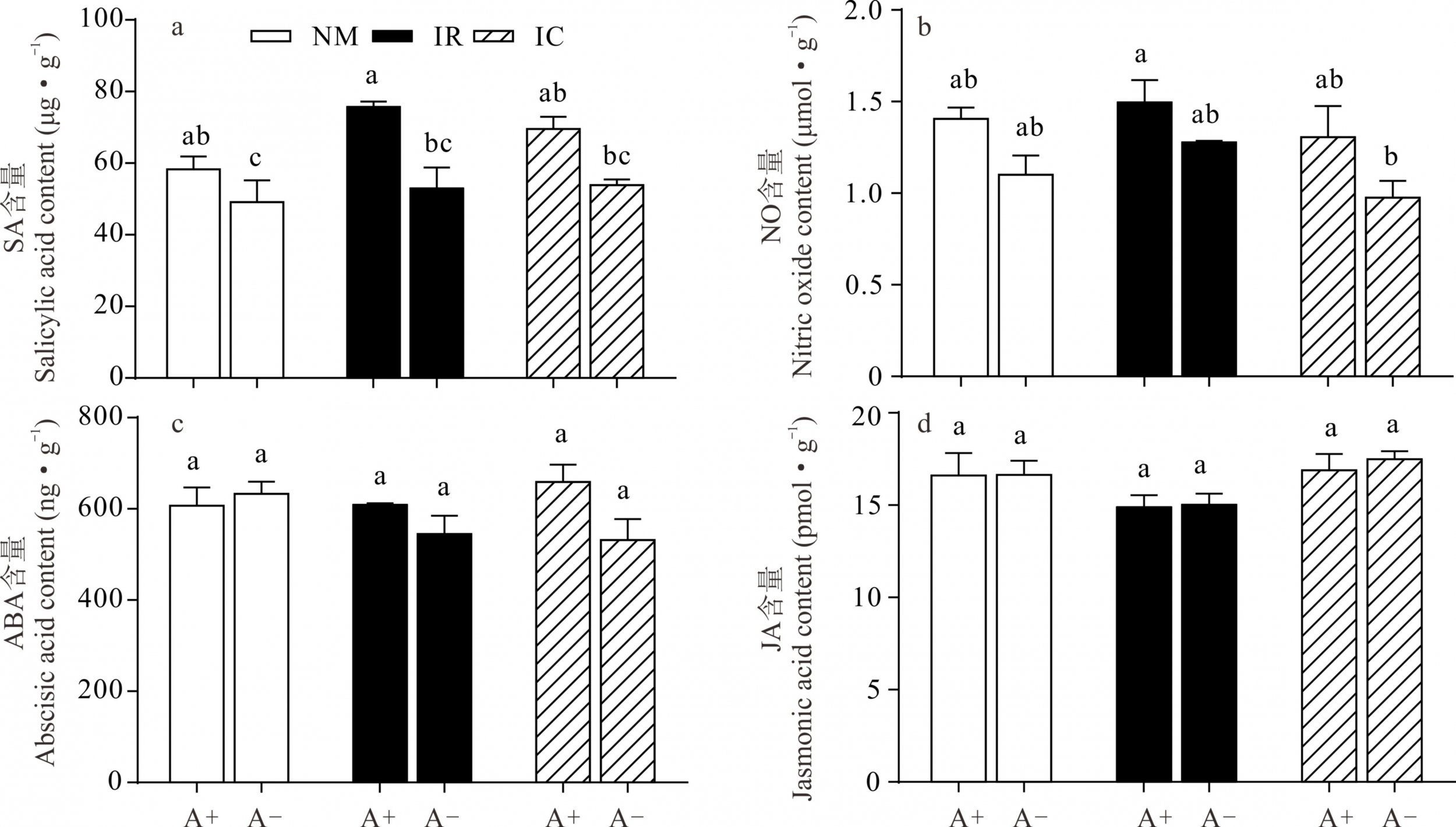
Legend: SA(a), NO(b), ABA(c) and JA(d) content of alfalfa under AM fungus and aphids treatment
Note: NM, sterile root treatment; IR, inoculation with Glomus within the root; IC, inoculation with Glomus juveniles; A, aphid treatment.
Aphid treatment significantly affected the SA and NO content of alfalfa. And all show a promoting effect. In the plants inoculated with Glomus intraroot, the SA content of alfalfa increased by 42.93% and the NO content increased by 17.06% compared with the non-inoculated treatment. In the plants inoculated with G. larvae, the increase was 29.01% and 33.91%, respectively, but the difference was not significant; while in the plants without AM fungus infection, the SA content of alfalfa was significant after the aphid treatment compared with the treatment without the infestation. Increased 18.54%, NO content increased 27.76%, but the difference was not significant.
The ABA and JA content of plant leaves were not affected by AM fungus treatment and aphid feeding.
in conclusion
The AM fungi G. intraroot and G. larvae significantly increased the biomass, number of branches and N and P absorption of alfalfa, and increased the activities of plant antioxidant enzymes POD and CAT and plant hormone signal substances after aphids feeding The content of SA and NO regulates the response of plants to aphids. It shows that AM fungi can inhibit the negative effects of aphids on plants after feeding and sucking.


PHONE:400-863-8520
MAILBOX:order@bestofbest.top
ADDRESS:Room 113, Building 29, Jiangsu Life Science and Technology Park, No. 9 Weidi Road, Xianlin Street, Qixia District, Nanjing
SUBMIT DEMAND
版权所有:南京维百瑞生物科技有限公司 宁ICP备 :12345678号 Powered by:YUNHAIWEB
 客服1
客服1 客服2
客服2